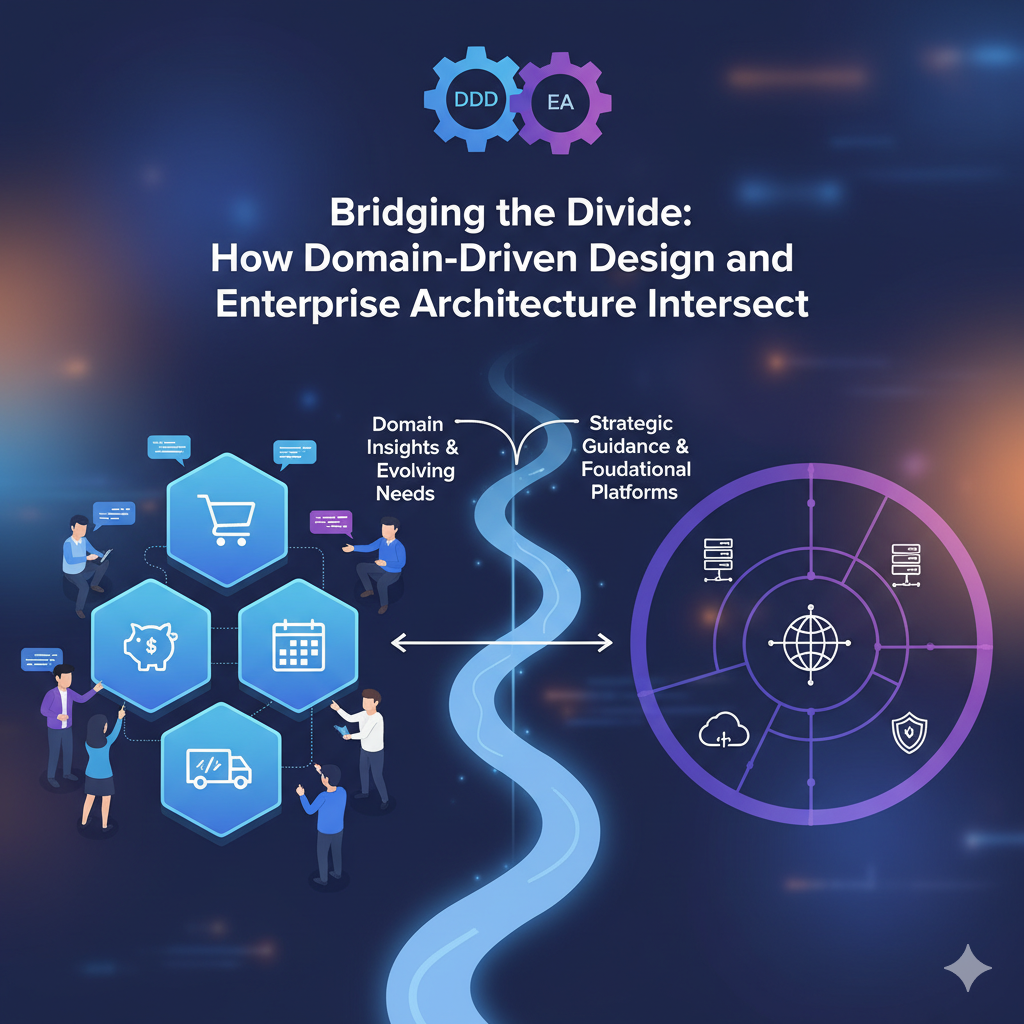

In the world of software development and business strategy, two powerful approaches, Domain-Driven Design (DDD) and Enterprise Architecture (EA), often operate with distinct yet overlapping goals. DDD champions the alignment of software with specific business domains, fostering deep understanding and tailored solutions. EA, on the other hand, provides the overarching structure, governing the relationships across an organisation’s business, information, and technology landscapes.
When these two disciplines meet, their interaction can create awkward organisational dynamics, prompting shifts, challenges, and opportunities for synergistic improvement. Let’s explore their mutual impacts and how we can optimise their collaboration.
The adoption of Domain-Driven Design inevitably sends ripples through any existing Enterprise Architecture practice.
1. Decentralising Architectural Stewardship
One of the most profound effects is the evolution of architectural decision-making. Historically, EA might have been seen as a central authority, dictating architectural standards. However, DDD empowers individual teams within their bounded contexts – distinct business areas with their own explicit models and language – to make architectural choices that best serve their specific domain.
This decentralisation isn’t about EA losing control; it’s about a shift from prescriptive mandates to enabling governance and strategic guidance. Enterprise architects transform into facilitators, providing guardrails and principles rather than rigid, detailed blueprints. While this transition can initially challenge established norms, it ultimately fosters greater agility and domain-specific excellence.
To truly thrive in this new landscape, EA practices can:
- Establish a Community of Practice: Create forums where domain architects and lead developers can share insights, discuss emerging patterns, and collaboratively evolve architectural best practices.
- Focus on High-Level Principles: Define overarching principles for security, scalability, integration, and data governance that all teams must adhere to, allowing flexibility within these boundaries.
2. The Business Domain as the Architectural Lens
DDD’s core tenet is its deep immersion in the business domain. This necessitates that Enterprise Architecture adopt an equally business-centric perspective, if it hasn’t already. The EA team must now explicitly understand, model, and represent the relationships between business capabilities, strategic initiatives, and the bounded contexts identified by DDD.
This shift ensures that EA’s models, such as capability maps and application portfolios, are living reflections of the organisation’s operational and strategic domains.
To enhance this business-centricity, EA practices can:
- Integrate Business Analysts and Domain Experts: Foster closer collaboration with those who possess deep business knowledge, ensuring architectural models accurately reflect business reality and strategy.
- Utilise Business-Oriented Modelling Tools: Employ tools and frameworks that visualise the alignment between business capabilities, DDD bounded contexts, and the underlying technology, making the value chain clear to all stakeholders.
3. Providing a Strategic Blueprint and Holistic Context
Without a strong EA vision, the autonomy of DDD teams, while powerful, could inadvertently lead to a fragmented landscape of isolated solutions that lack enterprise-wide integration. EA’s critical role here is to provide a “North Star” that helps teams understand how their bounded contexts contribute to and fit within the larger organisational ecosystem. This holistic view is crucial for identifying shared services, preventing redundant efforts, and ensuring that localised solutions don’t inadvertently create broader architectural debt.
For instance, EA might identify the need for a unified customer identity service that all domains leverage, preventing each domain from building its own.
To strengthen this strategic guidance, EA can:
- Communicate Vision through Reference Architectures: Develop concrete reference architectures and adaptable design patterns that teams can adopt, accelerating development and ensuring consistency.
- Collaborative Roadmap Creation: Engage DDD teams in the co-creation of architectural roadmaps, ensuring practical applicability and fostering collective ownership of the enterprise vision.
- Identify Cross-cutting concerns: Enable the provision of these shared services. Ensure that they are well-documented, easy to consume, scalable, and genuinely meet the needs of diverse domain teams.